


 Performance & SEO
 AI & agentic commerce

 Release tracker
Headless commerce on Adobe Commerce, built for speed and flexibility
Adobe Commerce runs catalog, cart and orders; you get any frontend you need: web, app, kiosk or marketplace.
Discuss a headless buildWhat’s included- GraphQL, API Mesh and App Builder
- Edge Delivery Services storefronts
- React, Next.js and mobile apps
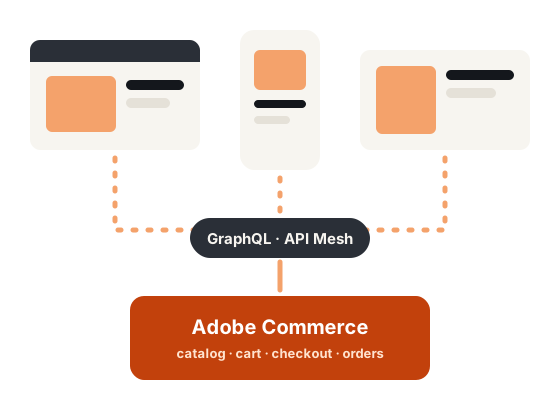
Headless commerce separates the storefront from Adobe Commerce: the platform still runs catalog, cart, checkout and orders, while a separate frontend calls it through GraphQL. It suits brands with several channels or a fully custom experience; for most stores that mainly need speed, a Breeze or Hyvä theme is the simpler choice.
How a headless request flows
The storefront and the commerce engine are separate applications that talk through one API.
 ShopperOpens a product page on web, app or kiosk.
 FrontendNext.js, React or Edge Delivery renders the page.
 API MeshOne GraphQL endpoint combines the data sources.
 Adobe CommerceCatalog, prices, cart, checkout and orders.
 PIM & CMSRich product data and editorial content.
When headless makes sense
Many channelsWebsite, app, in-store screens and portals share one backend. Frontend freedomModern frameworks without the Magento theme layer.
 Built for changeIntegrations in App Builder and API Mesh keep the core clean.
Which approach fits?
| Approach | Best for |
|---|---|
| Edge Delivery Services storefront | Fast, content-rich stores on Adobe |
| React / Next.js | Unique brand experiences |
| Apps and kiosks | Extra channels on one backend |
| Breeze or Hyvä (not headless) | Most stores that mainly need speed |
Headless adds a second application to maintain. If speed is the main goal, Breeze or Hyvä is usually cheaper.
What’s included

GraphQL APIsAdobe Commerce GraphQL for every channel.
API MeshCommerce, PIM, CMS and search in one endpoint.
App BuilderIntegrations and logic outside the core.

Edge DeliveryAdobe Commerce Storefront on Edge Delivery Services.
React & Next.jsCustom frontends with server rendering.

SEO built inServer rendering, URLs and structured data.
Is this right for you?
A good fit if- You sell through a website, an app and other channels from one catalog
- Your design team works in React or Next.js
- You want content and commerce combined on Adobe Edge Delivery Services
- You are moving to Adobe Commerce as a Cloud Service
 Probably not the right fit if
- Your main goal is speed: Breeze or Hyvä is cheaper and faster to deliver
- You do not have the budget to run and maintain a second application
 What you receive
- An architecture recommendation with costs
- GraphQL and API Mesh set-up
- The frontend with server rendering for SEO
- Monitoring, deployment pipeline and handover
One backend, every channel
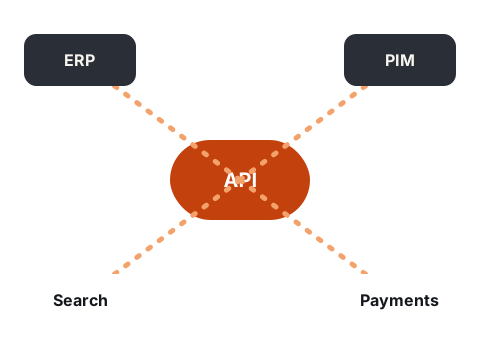
API Mesh combines Adobe Commerce with your PIM, CMS and search, so every frontend reads from one fast endpoint.
- Works with Adobe Commerce as a Cloud Service
- Existing PWA Studio sites reviewed
- Core Web Vitals planned from the start
Next.js sites we have built
Live projects from our portfolio.

Related guides
In-depth articles from the Mistri blog.
Frequently asked questions
Is headless better for SEO?
Only if the frontend renders pages on the server and handles URLs, metadata and structured data properly. We build that in from the start.
Do I need headless to have a fast store?
No. Breeze or Hyvä make most Adobe Commerce stores fast at lower cost. Headless is worth it for several channels or a fully custom experience.
What about PWA Studio?
We review existing PWA Studio storefronts and advise whether to maintain them or move to Edge Delivery Services or a custom React or Next.js frontend.
Does headless work with Adobe Commerce as a Cloud Service?
Yes. The Cloud Service is API-first, and customisations move to App Builder and API Mesh, which fits a headless architecture.
What is the difference between headless and composable commerce?
Headless separates the frontend from the commerce backend. Composable goes further and assembles several specialised services, such as search, CMS and PIM, through APIs.
Related services
Adobe Commerce developmentNew stores, B2B features and integrations on 2.4.9.Learn more → Custom extension developmentMagento 2 modules built to Adobe’s coding standards.Learn more →Custom web applicationsLaravel, Next.js, React and WordPress projects.Learn more →
 Our portfolioAdobe Commerce stores and web projects we have built.See the work →

Thinking about going headless?
Tell us your channels and goals. We will compare headless with a Breeze or Hyvä frontend for your case.